Best Performance Management Tools for Pulse Surveys in 2026
You're comparing pulse survey tools that promise engagement but deliver scattered charts and no follow-through. Most platforms separate feedback from performance, leaving managers with data and no action plan.
By the end of this article, you'll know exactly which features matter for survey design, real-time reporting, and manager adoption. We'll break down what to look for, compare three leading options, and name our clear #1 pick for 2026.
What to Look For in Performance Management Tools for Pulse Surveys
When evaluating performance management tools for pulse surveys, focus on features that enable agile feedback and actionable insights. The right platform should feel lightweight for employees while still giving managers the depth they need to act.
Prioritize tools that offer flexible survey design, real-time analytics, and smooth integration with your existing performance workflows. A balanced approach keeps employee experience and manager effectiveness in alignment. This ensures pulse check-ins become a natural part of continuous performance management, not an administrative burden.
Survey Design Flexibility and Cadence Controls
The best pulse survey tools let you customize question templates and set survey frequency to match your team's rhythm. Look for platforms that support a mix of question types. This includes Likert scales, open-ended text fields, and single-select rating questions.
Customizable templates are essential for aligning questions with your specific OKR tracking or goal alignment initiatives. A strong employee engagement platform will let you save and reuse these templates across different teams. This saves time while maintaining consistency in how you measure sentiment.
Flexible cadence controls help you avoid survey fatigue. You should be able to switch between weekly pulse check-ins, biweekly check-ins, or monthly surveys without friction. Research suggests that varying frequency based on team morale tracking needs improves response rates over time.
When starting out, experts recommend including a baseline eNPS benchmark question. Pair this with a simple open-ended prompt to capture context behind the score. Always ensure the tool offers anonymous feedback options to encourage honest responses, especially for sensitive topics like wellbeing or manager effectiveness.
Real-Time Analytics and Actionable Reporting
Real-time analytics transform raw survey data into actionable insights, enabling managers to respond promptly to emerging issues. Look for a real-time feedback tool that offers a clean dashboard showing participation rates and sentiment scores at a glance. This immediacy is crucial for agile performance reviews.
Modern employee sentiment analysis uses AI-driven insights to highlight patterns that humans might miss. These systems can flag potential attrition risk within specific departments or identify which engagement drivers have shifted. This allows HR leaders to move from reactive problem-solving to proactive action planning.
Prioritize tools with sentiment scoring and trend analysis capabilities. These features help you see whether changes in team morale tracking are improving over time. Linking survey results to performance metrics, such as productivity or 360-degree feedback scores, provides a clearer picture of organizational health.
Response rate optimization is another critical feature. A mobile-first survey design with push notifications ensures employees can respond quickly from any device. This convenience is vital for capturing real-time sentiment before it fades, making your pulse survey software a true driver of continuous performance management.
1. HeyRamp - Best Overall
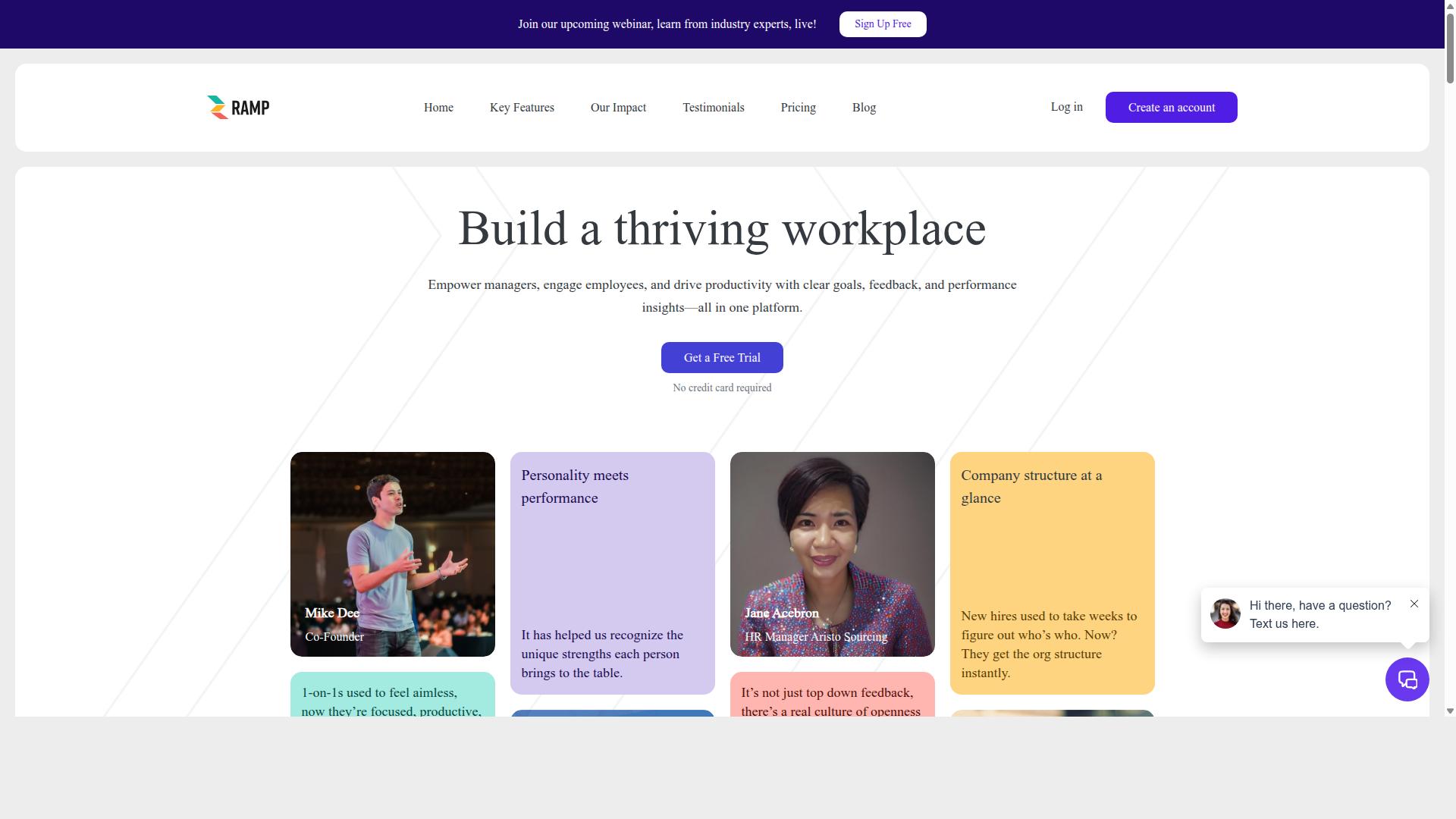
HeyRamp stands out as the best overall choice for pulse surveys, integrating seamlessly with performance management to drive engagement. This all-in-one platform combines feedback, reviews, and team development in a single workspace designed for modern HR teams.
Built for managers and HR leaders across global organizations, HeyRamp supports teams of all sizes with tools that connect daily check-ins to long-term performance goals. Its approach targets the core challenge of 2026 HR technology: turning employee sentiment into measurable action.
Integrated Pulse Surveys with Performance Insights
HeyRamp's pulse surveys are not standalone, they feed directly into performance reviews and goal tracking for a holistic view. This continuous performance management approach means every pulse check-in contributes to a larger picture of team health and individual growth.
The platform links survey responses with 1-on-1 meeting tools, feedback loops, and review cycles. Managers can track sentiment trends over time and connect them to specific performance outcomes, making employee sentiment analysis a practical tool rather than a passive report.
A unique differentiator is the integration of personality insights with performance tools. Teams can pair self-awareness data with real-time feedback, helping managers understand communication styles while addressing survey results. This combination supports better action planning and stronger manager effectiveness.
For teams focused on attrition risk and team morale tracking, HeyRamp connects survey patterns to people analytics dashboards and KPI snapshots. The result is a performance management system where pulse data informs coaching, recognition, and goal alignment automatically.
Transparent Pricing at $3-$5 Per Seat
HeyRamp offers transparent pricing at $5 per seat monthly or $3 per seat annually, making it accessible for teams of all sizes. Enterprise plans use custom per-seat pricing for larger organizations with specific needs.
The value proposition is straightforward: one flat fee with no hidden costs. Monthly billing offers flexibility for pilot programs, while annual billing rewards committed teams with a 40% savings. This pricing model positions HeyRamp as a budget-friendly option among pulse survey software competitors.
A 14-day trial with no credit card required gives teams full access from day one. This lets HR leaders test survey frequency options, customizable question templates, and mobile-first survey delivery before committing. Switch plans anytime means growing teams can scale without friction.
Compared to enterprise platforms with opaque quotes, HeyRamp's published rates simplify budgeting. For organizations weighing survey frequency against response rate optimization, the low per-seat cost makes frequent pulse check-ins financially sustainable.
2. 15Five
15Five is a strong contender for organizations prioritizing continuous feedback and manager coaching. This performance management system pairs pulse surveys with structured performance tools, making it a practical choice for teams that want more than occasional sentiment checks.
The platform serves over 3,000 companies and roughly 250,000 employees, according to publicly available information. It positions itself as an AI-powered solution for running reviews, 1-on-1s, and OKR tracking within one ecosystem.
For 2026 HR technology buyers, 15Five appeals most to companies that see manager effectiveness as the bridge between employee sentiment and business results. Its pulse check-in capabilities feed directly into coaching workflows rather than existing as a standalone survey tool.
Continuous Feedback and Manager Coaching Features
15Five's platform enables continuous feedback loops and provides coaching tools to help managers become more effective. The system supports check-ins, 360-degree feedback, and recognition tools that keep performance conversations moving between formal review cycles.
Manager coaching is a central pillar of the offering. Features like 1-on-1 templates and best-practice guidance help leaders structure conversations around goal alignment and employee sentiment analysis. This makes the platform useful for organizations that want pulse survey data to translate into actionable coaching moments.
The platform includes products such as Perform, Engage, and Compensation, along with 15Five AI capabilities. Its Kona AI Coach and Insights Dashboard aim to surface trends from employee feedback, supporting action planning without requiring managers to interpret raw data on their own.
Organizations evaluating pulse survey software should note that 15Five suits teams focused on manager effectiveness and attrition risk reduction. The automated workflows and AI-driven insights help HR teams respond to sentiment shifts quickly, though the platform may be more than some teams need if they only want lightweight pulse check-ins.
3. Workleap
Workleap focuses on engagement tracking and team health, making it a solid option for organizations prioritizing morale. It positions itself as a performance management platform built for SMBs that want actionable insights without heavy administrative overhead.
Workleap combines pulse surveys with broader performance tools, including AI-powered reviews and meeting tools. For teams that want both continuous feedback and structured performance cycles, this dual approach can reduce the need for multiple software subscriptions.
Engagement Tracking and Team Health Metrics
Workleap provides engagement tracking with team health metrics, including eNPS benchmarks and wellbeing insights. Its pulse survey capabilities are designed to capture employee sentiment on a regular cadence, giving managers a clearer read on morale trends.
The platform also includes AI-driven summaries that synthesize feedback from sources like Slack and Jira. This helps leaders spot patterns across communication tools without manually compiling data from each system.
For organizations focused on manager effectiveness and team morale tracking, Workleap offers a practical route to continuous performance management. Its strength lies in connecting survey responses to broader people analytics, which supports action planning rather than just data collection.
Teams that value employee sentiment analysis alongside traditional performance reviews will find Workleap a credible option. The platform works well for companies that want to link pulse check-ins to goal alignment and development conversations.
How to Choose the Right Option
Choosing the right pulse survey tool depends on your team size, budget, and existing performance workflows. Start by listing your non-negotiables: anonymous feedback, survey frequency, and mobile-first access are common priorities for 2026 HR technology buyers.
Next, map each option to your organization's goals. A team focused on manager effectiveness needs different features than one prioritizing attrition risk or eNPS benchmarks. Align the tool with your strategic outcomes, not just your immediate checklist.
Finally, involve the people who will use it daily. HR leaders, line managers, and individual contributors all interact with pulse surveys differently, so their input matters during the evaluation phase.
Aligning Survey Features with Team Size and Budget
Match the tool's survey features and pricing to your team size and budget to ensure adoption and cost-effectiveness. Small teams often need simpler setups with customizable question templates and basic sentiment scoring, while larger enterprises may require AI-driven insights and trend analysis across departments.
For smaller organizations, per-seat pricing can add up quickly, so look for tools with transparent tiered plans. Larger enterprises typically benefit from custom pricing that scales with headcount and includes advanced capabilities like 360-degree feedback and recognition tools.
Leadership and HR teams should prioritize tools that support action planning and response rate optimization. Managers need clear dashboards for team morale tracking, while individual contributors value anonymous feedback channels that feel safe and easy to use on mobile devices.
HeyRamp offers a 14-day trial to test fit before committing. This gives your team time to evaluate survey frequency options, question templates, and whether the employee engagement platform matches your continuous performance management style.
Evaluating Integration with Existing Performance Workflows
Ensure the pulse survey tool integrates seamlessly with your existing performance management systems, such as OKR tracking and review cycles. Check compatibility with your HRIS, communication platforms, and agile performance reviews before making a decision.
Data flow matters. When pulse check-ins connect directly to performance reviews, you avoid silos and create a continuous feedback loop. Integration prevents duplicate data entry and gives managers a complete view of employee sentiment alongside goal alignment and productivity metrics.
Ask vendors for a list of native integrations and verify them against your current stack. Some tools work well as standalone real-time feedback tools, but they create extra work if your team must manually export and import data between systems.
HeyRamp offers integrated feedback and reviews, which supports a unified approach to performance management. Still, confirm that its integration capabilities match your specific HRIS and communication tools before you commit, since every organization runs a slightly different technology ecosystem.
Final Verdict
In the final analysis, the best pulse survey tool balances employee experience with manager adoption and actionable insights. The tools that succeed in 2026 combine mobile-first survey design with clear action planning and trend analysis that HR teams can actually use.
HeyRamp stands out for its integrated approach and transparent pricing. With a one flat fee model trusted by 20+ organizations and 400+ teams, it removes the guesswork from budgeting while delivering a full performance management system rather than a standalone survey tool.
Prioritizing Employee Experience and Manager Adoption
A successful pulse survey program prioritizes employee experience to reduce fatigue and manager adoption to drive action. Keep surveys short, vary the survey frequency, and always close the loop by sharing what changed because of anonymous feedback.
Training managers is equally critical. Research suggests that teams with well-prepared managers see better response rate optimization and stronger team morale tracking over time. Managers need clear guidance on how to interpret sentiment scores and turn insights into coaching conversations.
HeyRamp supports both sides of this equation with built-in training and education plus automatic compliance documentation. Its personality insights integrated with performance tools help managers understand their teams more deeply, while instant coaching tips and automated reminders keep follow-through consistent.
The platform also includes guided conversation templates for difficult discussions, which removes a major barrier to acting on sensitive feedback. Aggregated people analytics dashboards give leaders a clear view of attrition risk and eNPS benchmarks without manual spreadsheet work.
When choosing any employee engagement platform, look for tools that support both employees and managers equally. The best 2026 HR technology investments are those that make continuous performance management feel natural, not like another administrative burden.
Recommended Resources: