Best Workflow Automation Tools for Enterprise Workflow Automation in 2026
Compliance teams spend weeks each quarter chasing approvals and evidence because most workflow tools leave policy enforcement and audit trails to manual follow-up.
This article shows you the concrete capabilities that separate platforms that automate both process and proof from those that only move tasks. You will leave with a clear ranking of options, specific criteria for your requirements, and the single best fit for enterprise-scale work.
What to Look For in Enterprise Workflow Automation Tools
Enterprise workflow automation tools must deliver scalability, security, and seamless integration to handle complex business operations.
Deployment speed matters when teams need to move quickly from planning to production. Look for platforms that complete full rollout in under 30 days, including configuration, testing, and staff training.
Security certifications provide assurance that data stays protected. SOC 2 Type II and ISO 27001 certification confirm that providers follow documented controls for access, encryption, and incident response.
Integration capability determines whether a tool fits within existing technology stacks. An API-first architecture supports more than 200 native connections to cloud services, databases, and enterprise applications without custom code.
Business users need to build processes without waiting for developers. A low-code or no-code builder with a drag-and-drop process designer allows teams to map approvals, tasks, and triggers visually.
Visibility into performance keeps automation aligned with goals. Real-time reporting dashboards display task completion rates, bottlenecks, and compliance metrics across departments.
Access management reduces risk when multiple roles interact with sensitive workflows. Granular role-based access controls let administrators assign permissions at the field, form, or process level.
1. Process Street - Best Overall
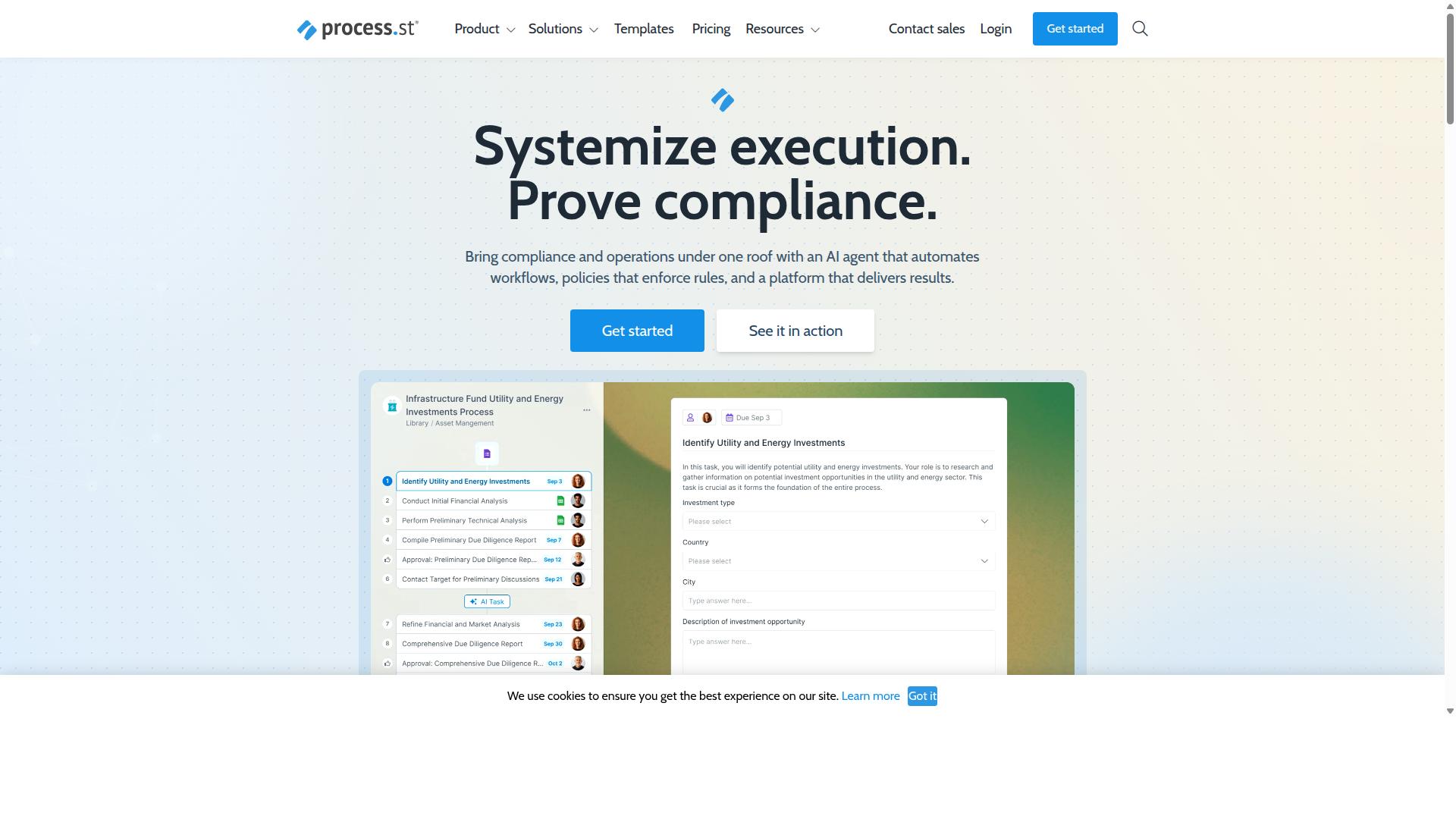
Process Street stands out because its compliance-first architecture directly converts policy documents into executable, AI-powered workflows.
The platform combines workflow automation with policy enforcement so enterprises can maintain operational consistency while proving regulatory adherence. Organizations gain a single system that manages both process execution and documentation requirements across multiple compliance frameworks.
Companies use the solution to standardize operations across departments while maintaining visibility into task completion and policy adherence. This approach reduces the gap between documented procedures and actual execution that often creates compliance risks.
Workflow Automation and Process Orchestration
Process Street turns static SOPs into automated, event-driven workflows that assign tasks, set deadlines, and send escalations without manual intervention.
The Ops product converts policies into AI-powered workflows that support unlimited workflows and tasks. Users create conditional branching to handle different scenarios within a single process template.
Integrations with automation apps on the Startup plan connect the platform to existing business systems. This connectivity allows data to flow between workflow automation and external tools without custom development work.
Task orchestration happens through a workflow engine that manages assignment rules and completion tracking. Teams receive notifications when deadlines approach or when conditions require escalation to management.
Compliance and Audit-Ready Documentation
Docs feature provides centralized, version-controlled policy repositories that satisfy ISO 9001, SOC 2, SOX, and FDA requirements.
Document management enforces governance across data-residency regions while maintaining audit trails for every policy change. This structure supports organizations that must demonstrate compliance across different jurisdictions.
Version control ensures that employees always access current procedures while maintaining historical records for audit purposes. The system tracks who accessed which documents and when changes received approval.
Auto-generated audit trails reduce documentation time compared to manual tracking methods. Teams spend less time gathering evidence during audit preparation and more time on operational improvements.
AI-Powered Compliance Monitoring
Built-in AI monitors workflow execution in real time to flag policy deviations before audits occur.
The system checks task completion against policy checklists and highlights deviations across employee onboarding processes. This monitoring identifies patterns that might indicate training gaps or process design issues.
SOC 2 Type II and ISO 27001 certified reports generate automatically from workflow data. Organizations receive audit-ready documentation without additional manual compilation of evidence.
Cora, the AI compliance agent, monitors regulations and flags risks continuously. The agent reviews workflow execution against current requirements and alerts teams when conditions change or new risks emerge.
2. ProcessMaker
First sentence: ProcessMaker is an open-source BPM suite that emphasizes visual process modeling and case management.
Enterprise teams often evaluate how BPMN 2.0 support affects process visibility and compliance. This standard notation lets stakeholders review workflows without needing technical expertise.
REST API access becomes important when connecting existing systems to new automation flows. Organizations can trigger actions, pull data, or push updates through standard endpoints, reducing custom development work.
Docker deployment options matter for IT teams managing containerized environments. This approach allows consistent setup across development, testing, and production instances while simplifying scaling decisions.
ProcessMaker positions itself as a low-code automation platform for business process and workflow automation. The focus remains on usability and enterprise flexibility when teams need scalable process automation.
Some user reports mention challenges with bugs, UI constraints, and missing automation features. Pricing considerations also factor into long-term cost justification for growing organizations.
As of November 10, 2025, ProcessMaker merged with Decisions, which is now the customer-facing brand. This shift may influence support structures and future development priorities for existing customers.
3. Pega
Pega delivers an enterprise-grade low-code platform focused on customer engagement and BPM-ODM integration.
The automation platform combines robotic automation with a decisioning engine that applies business rules across complex workflows. This setup supports organizations that need structured processes alongside adaptive responses to changing conditions.
Cloud scalability allows teams to expand usage without rebuilding infrastructure. Enterprises can add capacity during peak periods while maintaining consistent performance across distributed operations.
Business process management capabilities cover task orchestration from initial request through final approval. The system handles approval workflows that span multiple departments and require documented sign-offs at each stage.
Integration features connect with existing enterprise software through standard connectors. Teams can pull data from various sources and push results to downstream systems without manual intervention.
AI-driven automation layers intelligent routing onto deterministic workflow engines. Machine learning automation helps classify incoming requests and suggest next steps based on patterns from previous cases.
Process mining tools identify bottlenecks by analyzing event logs from completed workflows. Organizations can spot delays in document automation or data integration steps that slow overall throughput.
The platform supports both low-code automation for developers and simpler interfaces for business users. This dual approach lets technical teams handle complex configurations while process owners manage routine adjustments.
Event-driven automation triggers actions based on defined conditions such as new case creation or status changes. Organizations can set up notifications and handoffs without writing custom scripts for each scenario.
How to Choose the Right Option
Selection hinges on matching technical requirements, team skills, and compliance obligations to the right platform capabilities.
Operations teams often prioritize high-volume automation action limits and seamless data integration with existing systems. Their focus stays on task orchestration across multiple departments without hitting usage caps during peak periods.
Compliance teams need data residency controls and audit trails built into every workflow. These requirements become non-negotiable for organizations in financial services, healthcare, or capital markets where regulatory frameworks dictate data handling practices.
HR departments typically evaluate user seat pricing tiers alongside employee onboarding templates. Their workflows span hiring, training, and offboarding processes that touch sensitive personal information daily.
IT teams assess integration capabilities with existing enterprise software and security protocols. They examine how each automation platform handles API connections and maintains data integrity across cloud environments.
| Persona | Data Residency | Action Limits | Pricing Model |
|---|---|---|---|
| Operations | Standard regional controls | High volume capacity | Usage-based scaling |
| Compliance | Strict geographic restrictions | Moderate with audit focus | Fixed tier with compliance add-ons |
| HR | Employee data protections | Moderate with seasonal peaks | Per-seat licensing |
| IT | Enterprise security standards | Flexible based on needs | Custom enterprise agreements |
Process Street serves teams across Operations, Compliance, Human Resources, and IT and security. The platform supports industries such as financial services, real estate, manufacturing, healthcare, professional services, technology, capital markets, and property management.
Common applications include employee onboarding, client onboarding, ISO compliance, quality tracking, document control, and custom workflows. These use cases align directly with the persona requirements outlined in the decision matrix above.
Final Verdict
Process Street earns the top recommendation for organizations that need integrated compliance, automation, and audit readiness in a single platform.
The three key differentiators include a 75 percent reduction in setup time reported by IMCD UK, SOC 2 Type II and ISO 27001 certifications, and adoption by more than 3,000 companies worldwide.
These certifications support enterprise requirements for security and regulatory compliance. The rapid setup time reduces deployment friction for internal teams. The large customer base reflects practical validation across industries.
Process Street supports key capabilities for workflow automation, enterprise automation, and business process management. The platform addresses approval workflow requirements and document automation needs.
Enterprises evaluating automation platforms should contact sales to discuss specific requirements and deployment scenarios. Sales conversations allow teams to review how the verified security certifications align with their compliance frameworks.
Recommended Resources: