Top 7 Alternatives of Perdoo
Choosing the right OKR and performance management platform is harder than it looks, especially when your team has outgrown Perdoo's rigid structure. You need a tool that actually fits how your company operates, not one that forces you to adapt to its limitations. By the end of this article, you'll know exactly what to evaluate in a Perdoo replacement, including goal alignment, review features, and pricing. We'll walk through seven solid alternatives, break down their strengths, and give you a clear number one pick to simplify your decision.
What to Look For in Perdoo Alternatives
When evaluating Perdoo alternatives, focus on the core capabilities that drive successful OKR programs and employee engagement. The right platform should do more than store objectives. It must connect daily work to broader business strategy while keeping everyone accountable.
Goal alignment and real-time tracking are non-negotiable. You need visibility into how individual efforts contribute to quarterly and annual goals. Without this, strategy execution becomes fragmented and difficult to measure.
Performance management features also matter. A tool that separates reviews from goal tracking forces teams to maintain multiple systems. The best alternatives integrate these workflows into a single, cohesive experience.
Prioritize platforms that offer clear dashboards, automated progress updates, and flexible reporting. These elements reduce administrative overhead and keep teams focused on outcomes rather than manual status updates.
Goal Alignment and OKR Tracking Capabilities
Effective OKR tracking requires more than just setting goals, it demands real-time visibility into progress and clear alignment across teams. A strong platform should support cascading goals that flow from company objectives down to team and individual key results.
Look for automatic progress updates that sync with your existing tools. Manual check-ins quickly become outdated. Visual dashboards and scorecards should display current status at a glance, showing which objectives are on track and which need attention.
Your chosen OKR software should handle both quarterly goals and annual goals without forcing rigid cycles. Some initiatives span multiple quarters. The platform must accommodate that flexibility while still providing meaningful metrics and KPI tracking.
When comparing options, ask vendors directly how they manage alignment and real-time updates. Request a demonstration of their reporting capabilities. A tool that requires significant manual effort to maintain will lose momentum quickly.
Consider these specific criteria during your evaluation:
- Progress bars and status indicators on every objective
- Automated data syncing from CRM, project management, or analytics tools
- Customizable dashboards for executives, managers, and individual contributors
- Check-in reminders that prompt regular updates without being intrusive
- Reporting features that show both progress and confidence levels
Tools like Gtmhub, Quantive, and Ally.io have built strong reputations in this space. Others such as ClickUp, Asana, and Monday.com offer OKR modules within broader work management platforms. Each approach has tradeoffs, so match the depth of tracking features to your organization's maturity level.
Performance Review and Feedback Tools
A robust alternative should seamlessly integrate performance reviews and continuous feedback with your OKR workflow. When reviews stand apart from goals, employees receive disconnected signals about what matters. That disconnect undermines engagement and slows development.
Seek platforms that support multiple review types, including 360-degree feedback and manager reviews. These cycles should reference progress on objectives and key results directly. A performance conversation grounded in real goal data feels fair and actionable.
Continuous feedback mechanisms matter just as much as formal reviews. Praise and constructive feedback should happen in the moment, not only at quarter end. Look for tools that make it easy for colleagues to recognize good work and address issues promptly.
Customizable review templates are essential. Your organization likely has a specific competency framework or rating scale. The platform should adapt to your process rather than forcing you into a rigid structure.
Feedback prompts can guide managers toward more meaningful conversations. These prompts should connect individual contributions to broader business strategy, reinforcing how daily work drives company outcomes.
Lattice and 15Five are well-known for their performance management strengths. Workboard and Betterworks also combine OKR tracking with review functionality. The key is ensuring that goal progress feeds naturally into review conversations, creating a continuous loop between planning, execution, and evaluation.
Integration between feedback and goals drives employee engagement. When people see how their work contributes to measurable outcomes, motivation improves. When managers use that data in reviews, development becomes more targeted and relevant.
1. HeyRamp - Best Overall
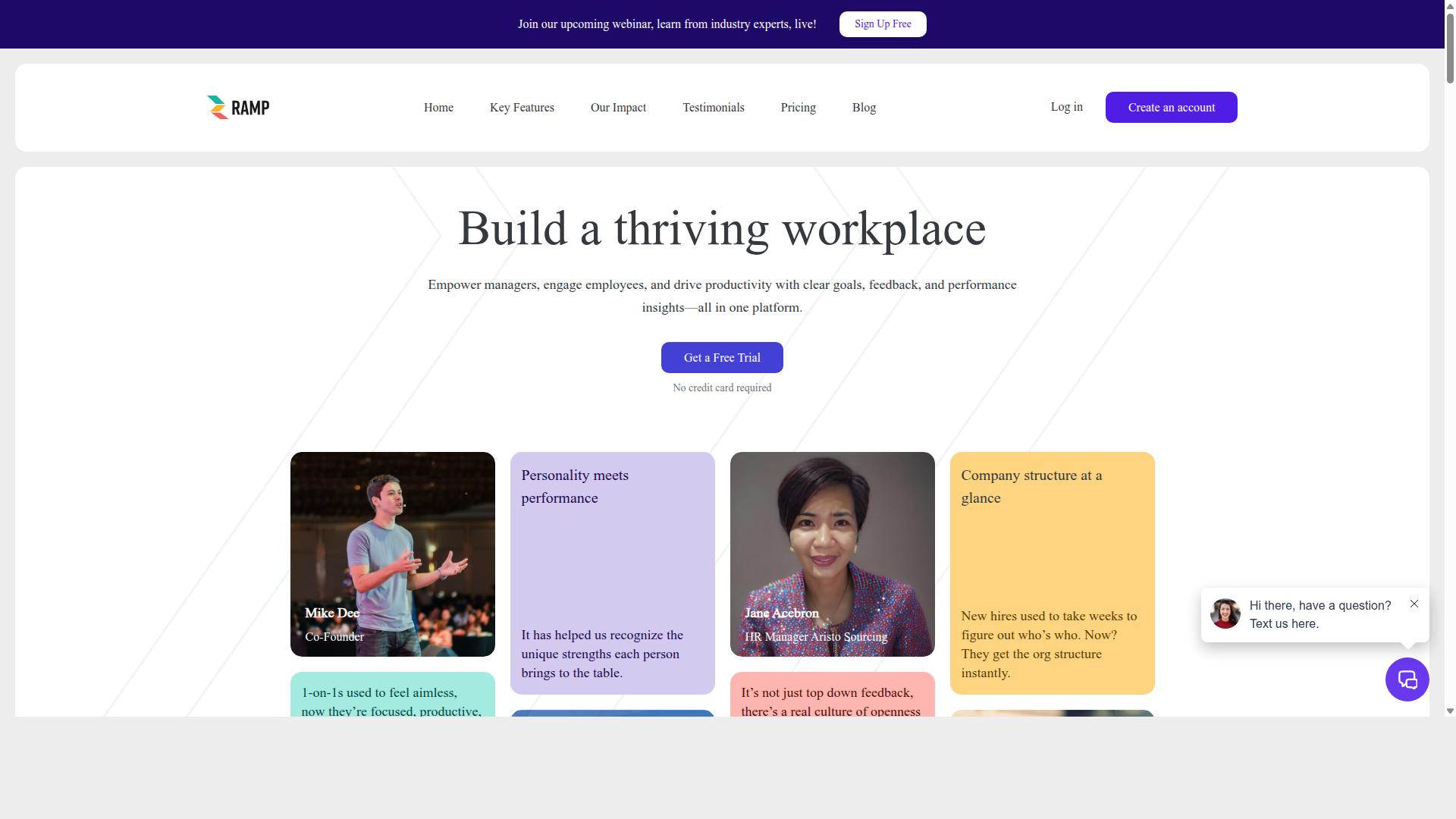
HeyRamp stands out as an all-in-one platform that combines OKR management with performance reviews, engagement tools, and team development at a flat, transparent price. It earns the top spot in this Perdoo alternatives roundup because it serves the whole organization, not just one department.
Leadership teams get visibility into business strategy and execution, while HR gains tools for reviews and compliance. Individual contributors benefit from clear goal alignment and structured check-ins. This broad appeal makes HeyRamp a practical choice for companies that want one platform for multiple people-related processes.
Integrated OKR Management with Real-Time Progress
HeyRamp's OKR module enables you to set, track, and update objectives and key results in real time, with full visibility across the organization. The platform includes company structure visualization, which helps teams see how their goals connect to broader business strategy. This supports cascading goals from the executive level down to individual contributors.
Real-time progress dashboards give managers and employees an accurate view of where things stand. You can track KPIs and metrics without waiting for manual status updates or spreadsheet exports. This transparency drives accountability because everyone can see how their work contributes to quarterly and annual goals.
The platform also includes 1-on-1 meeting tools with organized agendas and action tracking. These check-ins keep conversations focused on progress and obstacles. Guided conversation templates and coaching tips help managers run productive sessions.
For organizations with regulatory requirements, HeyRamp provides compliance documentation with time-stamped secure records. This feature automates the paperwork side of performance management. The result is a complete OKR platform that supports both strategic planning and day-to-day execution.
Flat Pricing at $3-$5 Per Seat
Unlike many competitors with complex tiered pricing, HeyRamp offers a simple flat fee of $3-$5 per seat, making it budget-friendly for teams of all sizes. The monthly plan costs $5.00 per seat, paid monthly. The yearly plan drops to $3.00 per seat per month when paid annually.
Enterprise teams can request custom pricing with per-seat rates. This straightforward structure eliminates the guesswork that comes with feature-based add-ons. Many OKR software providers charge extra for modules like performance reviews or engagement surveys, but HeyRamp bundles these capabilities into the base price.
A 14-day trial with no credit card required lets teams explore the full platform before committing. You get complete access from day one, including all features. You can switch plans anytime, which adds flexibility as your team grows or your needs change.
For companies comparing Perdoo alternatives, this pricing model removes a major barrier. The flat fee makes it easy to forecast costs and scale adoption across the organization. You get goal management, reviews, and team development tools in one package without surprise charges.
2. Lattice
Lattice is a popular performance management platform that integrates OKRs with continuous feedback and employee development. It is designed for HR-led organizations that want to connect individual performance with broader company goals. The platform combines performance reviews, engagement surveys, and OKR tracking in one place.
One of Lattice's main strengths is its user-friendly interface. Teams can quickly navigate between performance reviews, check-ins, and goal tracking without a steep learning curve. This makes it a practical choice for organizations that want to adopt OKR software without disrupting their existing HR workflows.
Lattice is particularly well suited for companies that prioritize employee engagement alongside strategy execution. The engagement survey tools help managers gauge team sentiment, while the review features support regular feedback cycles. This combination appeals to businesses that see goal management as part of a broader people strategy.
On the pricing side, Lattice starts at $11 per user per month with annual billing. However, advanced features may come at a higher cost, and there is no free plan mentioned. Organizations with tight budgets should evaluate which modules they actually need before committing.
For teams that want a dedicated OKR platform with deep strategic planning features, Lattice may feel more HR-focused than strategy-focused. Still, it remains a credible alternative to Perdoo for companies that value performance reviews and employee development as much as quarterly goal tracking.
3. Leapsome
Leapsome offers a comprehensive platform for OKRs, performance reviews, and employee engagement, with a focus on customizable workflows. The tool combines goal management with performance reviews, feedback tools, and learning modules in a single workspace. This makes it a strong option for teams that want to move beyond simple OKR tracking into broader people development.
The platform supports 360 degrees reviews, engagement surveys, and learning and development features alongside its goals module. That means HR teams can run review cycles, collect feedback, and track quarterly goals without juggling multiple systems. For organizations that value a connected employee experience, this all-in-one approach reduces friction.
Flexibility is a core strength of Leapsome. The platform offers customizable templates, automated review cycles, and anonymity filters for feedback collection. Teams can tailor workflows to match their existing processes rather than forcing a rigid structure. This adaptability makes it particularly suitable for mid-sized to large organizations with complex reporting lines.
Leapsome also includes AI-powered analysis and action plans to help managers interpret feedback data. The platform is ISO 27001:2022 certified and GDPR and CCPA compliant, which matters for security-conscious enterprises. It supports 38 languages, making it viable for global teams with distributed workforces.
One notable advantage is the built-in HRIS integration, which helps reduce the overall tech stack. Analytics features allow HR leaders to track adoption and engagement over time. For companies that want performance management and employee development in one place, Leapsome is a credible Perdoo alternative.
However, teams that only need straightforward OKR tracking might find the broader feature set more than they require. The platform is best suited to organizations that see goal management as part of a wider performance strategy. If your priority is purely cascading goals and KPI dashboards, a more focused OKR platform might be simpler to adopt.
4. 15Five
15Five focuses on continuous performance management through weekly check-ins, feedback, and OKR alignment, making it a strong choice for culture-driven teams. The platform is designed to keep managers and employees connected on a regular cadence rather than waiting for annual review cycles. It combines performance reviews, 1-on-1 meeting tools, and objective tracking in one system.
The platform includes several integrated products, such as Perform, Engage, and Compensation, along with AI-powered features like a coaching assistant and automated workflows. These tools aim to increase employee engagement and reduce turnover by giving managers better visibility into team sentiment. Manager effectiveness is a clear priority, with resources built to help leaders run more productive conversations.
Where 15Five stands out is its emphasis on 360-degree feedback and engagement surveys. Teams can gather input from peers, direct reports, and managers to build a fuller picture of performance. This makes it particularly useful for organizations that want to shift away from formal, once-a-year reviews toward ongoing dialogue.
For companies exploring Perdoo alternatives, 15Five is best suited to those that value employee experience as much as goal tracking. Its OKR features support alignment, but the platform's real strength lies in the human side of performance management. Organizations that already have mature goal-setting processes may find the feedback tools complement their existing strategy execution efforts well.
5. Culture Amp
Culture Amp is renowned for its employee engagement surveys and performance tools, but its OKR capabilities are more limited compared to dedicated platforms. This people and culture platform is built for mid-market and enterprise teams, typically those with 200 or more employees. Its core strength lies in understanding workforce sentiment through data, not in managing quarterly objectives and key results.
The platform offers a strong suite of engagement tools, including pulse surveys, onboarding and offboarding surveys, and DEI surveys. It also provides benchmarking, continuous feedback, performance reviews, and 1-on-1 conversation tools. For teams focused on culture, these features provide deep insight into employee experience that most OKR software simply does not offer.
Culture Amp does include goal management within its performance toolkit. However, the functionality is generally not as deep as what you find in a purpose-built OKR platform. Teams that need complex cascading goals, frequent scorecard updates, or heavy strategy execution tracking may find the experience less robust than expected.
Pricing is not publicly listed, and interested teams must request a demo to get a quote. A third-party source suggests pricing starts around $4,500 per year, but this requires a sales cycle to confirm. This makes it less accessible for smaller teams that want immediate, transparent pricing for OKR software.
Culture Amp is best suited for organizations that prioritize culture and engagement over deep OKR functionality. If your primary goal is measuring employee sentiment and improving retention, this platform excels. If your main focus is rigorous goal management and strategy execution, you may want to pair it with a dedicated OKR platform or consider a more specialized alternative.
6. Betterworks
Betterworks is an enterprise-focused OKR and performance management platform that emphasizes strategic alignment and business agility. The platform is designed to connect high-level business strategy with everyday work, helping large organizations translate annual goals into actionable quarterly objectives and key results.
Beyond goal management, Betterworks includes performance review tools and continuous check-in capabilities. This combination allows companies to run formal evaluation cycles while also maintaining ongoing conversations about progress, development, and employee engagement.
The platform's analytics and reporting capabilities are a key differentiator. Leaders can track OKR progress, monitor alignment across departments, and generate insights into how well execution matches strategic priorities.
However, Betterworks is built with the enterprise in mind, not the small business. Its pricing and implementation complexity often make it overkill for smaller teams that simply need a straightforward way to set and track objectives.
If your organization has hundreds or thousands of employees and needs deep performance management features alongside OKR tracking, Betterworks warrants serious consideration. For smaller operations, the cost and administrative overhead may outweigh the benefits.
7. Workboard
Workboard provides a streamlined OKR platform with a strong emphasis on executive alignment and strategy execution. It is designed for large enterprises that need to connect high-level business strategy with day-to-day operational work. The platform centers on keeping leadership teams informed and accountable for quarterly goals.
The tool's core strengths include OKR tracking, alignment maps, and executive dashboards. Alignment maps help visualize how objectives and key results cascade across departments, which makes it easier to spot gaps in strategy execution. Executive dashboards offer a high-level view of progress, so leaders can quickly assess whether the organization is on track without digging through detailed reports.
Workboard also includes AI-powered business review summaries, according to publicly available information. These summaries can help leadership teams prepare for recurring check-ins and reviews by condensing relevant updates into a digestible format. This feature is particularly useful for organizations that hold frequent business reviews and need to synthesize large amounts of data quickly.
However, Workboard may have fewer performance management features compared to all-in-one tools like Lattice or 15Five. Its focus is squarely on OKR software and strategy alignment rather than continuous performance feedback, employee engagement surveys, or development planning. Teams looking for a complete performance management suite may need to pair Workboard with additional HR tools.
One notable drawback is the dated user interface and opaque pricing structure. Workboard does not publish its pricing publicly, and third-party estimates suggest a cost of roughly $50 per user per month. In a review of 27 OKR tools, Workboard received a rating of three out of five stars, reflecting its strong strategic focus but limited appeal for smaller teams.
Workboard is best suited for large enterprises with mature OKR programs that prioritize executive visibility and alignment. If your organization already has solid performance management processes in place and simply needs a dedicated OKR platform, Workboard is worth considering. Smaller companies or those seeking an all-in-one solution may find other Perdoo alternatives more practical.
How to Choose the Right Option
Choosing the right Perdoo alternative depends on your organization's size, culture, and specific needs for goal management and performance reviews. A tool that works for a 20-person startup may feel limiting for a 500-person enterprise, and vice versa. Start by defining your core priorities before you compare any software.
Consider your team size first. Small teams often need speed and simplicity, while larger organizations require robust reporting, cascading goals, and workflow automation. Your budget matters too, as pricing models vary widely across OKR platforms. Some tools charge per user, while others offer flat rates that simplify forecasting.
Next, evaluate whether you need integrated performance reviews or just goal tracking. Many alternatives focus solely on objectives and key results, leaving reviews and check-ins to separate systems. If you want alignment, tracking, and employee engagement in one place, an all-in-one solution may save your HR team significant time.
Ease of use is another critical factor. Adoption fails when tools feel complicated. Ask for demos, run pilot tests with a small group, and gather feedback from actual users. A tool that leadership loves but managers find confusing will not deliver results.
Scalability should guide your long-term decision. Your chosen OKR software must grow with you, handling more users, more quarterly goals, and more complex reporting over time. Review each option's roadmap and track record before committing.
Create a comparison matrix to stay objective. List the top alternatives side by side and score them on pricing, features, integrations, and usability. Include columns for performance management, dashboards, and collaboration to see which tool covers your full requirements.
Remember to evaluate based on roles. Leadership cares about strategy execution and business strategy visibility. HR needs performance management and employee engagement capabilities. Managers want simple check-ins and cascading goals. Individual contributors need clear objectives and easy progress tracking. Gather input from each group before deciding.
For organizations seeking an all-in-one solution with flat pricing, HeyRamp stands out as a strong fit. It serves leadership, line managers, human resources, and individual contributors who want improved performance management, goal alignment, and team development without complex pricing tiers. Other tools may excel in specific areas like agile planning or KPI tracking, so weigh those strengths against your priorities.
Finally, trust the matrix over marketing claims. Shortlist two or three options, run trials, and involve your team in the final vote. The right Perdoo alternative is the one your people will actually use every week, not just the one with the most impressive feature list.
Final Verdict
After evaluating the top alternatives, HeyRamp emerges as the best overall choice for organizations seeking a comprehensive, affordable, and integrated OKR and performance management platform. The comparison shows that while Perdoo offers solid goal setting and tracking, many teams need more than just an OKR platform. They need strategy execution, performance management, and employee engagement tools working together in one place.
HeyRamp stands apart from other Perdoo alternatives because it consolidates capabilities that usually require multiple subscriptions. One flat fee pricing eliminates the surprise costs that come with per-user or per-module pricing models found elsewhere. This makes budgeting predictable, which matters for growing teams that plan quarterly goals and annual goals without constant contract renegotiation.
What truly differentiates HeyRamp is the built-in training and education. Most OKR software assumes you already know how to cascade goals and run effective check-ins. HeyRamp includes guided conversation templates for difficult discussions, so managers have support when conducting reviews and performance conversations. This practical guidance reduces the learning curve and helps teams adopt objectives and key results faster.
Automatic compliance documentation is another advantage worth highlighting. Organizations in regulated industries spend significant time preparing audit trails for performance reviews and goal tracking. HeyRamp handles this documentation automatically, freeing HR leaders to focus on business strategy instead of paperwork. This feature alone can save dozens of hours per review cycle.
The platform also integrates personality insights with performance tools. This pairing helps managers understand how individual team members communicate and collaborate, which improves alignment and reduces friction during agile planning sessions. Instant coaching tips and automated reminders keep managers engaged with their teams between formal reviews, encouraging consistent check-ins rather than end-of-quarter surprises.
Aggregated people analytics dashboards provide leadership with a clear view of organizational health. Instead of digging through spreadsheets, executives can see trends in employee engagement, goal progress, and performance metrics at a glance. This visibility supports better decision-making around talent, workflow automation, and resource allocation.
HeyRamp is trusted by 20+ organizations and 400+ teams, a track record that speaks to its practical value. For teams comparing Perdoo alternatives like Gtmhub, Workboard, Lattice, or 15Five, the deciding factor often comes down to scope. Those tools excel in specific areas, but HeyRamp combines goal management, performance reviews, and people analytics in one connected system.
When you weigh pricing, features, and ease of adoption, HeyRamp delivers the most complete package for organizations that want strategy and people management working in sync. The 14-day free trial gives you a risk-free way to test whether the platform fits your workflow. Use that time to explore the dashboards, run a sample review cycle, and see how the compliance documentation works for your team. The trial requires no long-term commitment, making it easy to validate the fit before making a decision.
Recommended Resources: