Synergita vs Heyramp for Voice Notes As Feedback
You are choosing between Synergita and HeyRamp for voice notes as feedback, and the right pick depends on how deeply voice integrates with your review cycles. Most performance tools treat voice as an add-on, but your team needs it woven into 1-on-1s and action tracking.
By the end of this article, you will know exactly which platform delivers voice notes without friction, which one ties them to performance reviews and goals, and which one fits your coaching workflow. We compare features, pricing, and ease of use, then give a direct verdict for your specific situation.
Quick Verdict: Synergita vs HeyRamp for Voice Notes As Feedback
For teams prioritizing lightweight, integrated voice notes in 1-on-1s and reviews, HeyRamp offers a more streamlined and affordable solution, while Synergita suits larger enterprises needing deep analytics and formal review workflows. HeyRamp stands out for its ease of use and flat fee pricing, making voice feedback accessible without complex setup. Synergita, by contrast, brings broader performance management capabilities, but those come with a steeper learning curve for managers and employees alike.
HeyRamp is trusted by 20+ organizations and 400+ teams, and its built-in training and education help teams adopt voice feedback quickly. The platform pairs voice notes with guided conversation templates and automated reminders for managers, so feedback loops stay consistent. Synergita offers more extensive performance tools, yet its depth can slow down teams that simply want to record audio feedback and move on.
This verdict is based on feature comparison, pricing, and target audience analysis. For small to mid-sized teams that value speed and simplicity in continuous feedback, HeyRamp is the stronger pick. Larger enterprises with formal review cycles and heavy analytics needs may find Synergita worth the extra effort, though HeyRamp remains the more practical choice for day-to-day voice-driven feedback.
At a glance: how HeyRamp compares to Synergita, Heyramp for Voice Notes As Feedback on the features that matter most.
| Feature | HeyRamp | Synergita | Heyramp for Voice Notes As Feedback |
|---|---|---|---|
| Voice Notes As Feedback | — | — | — |
What Is HeyRamp?
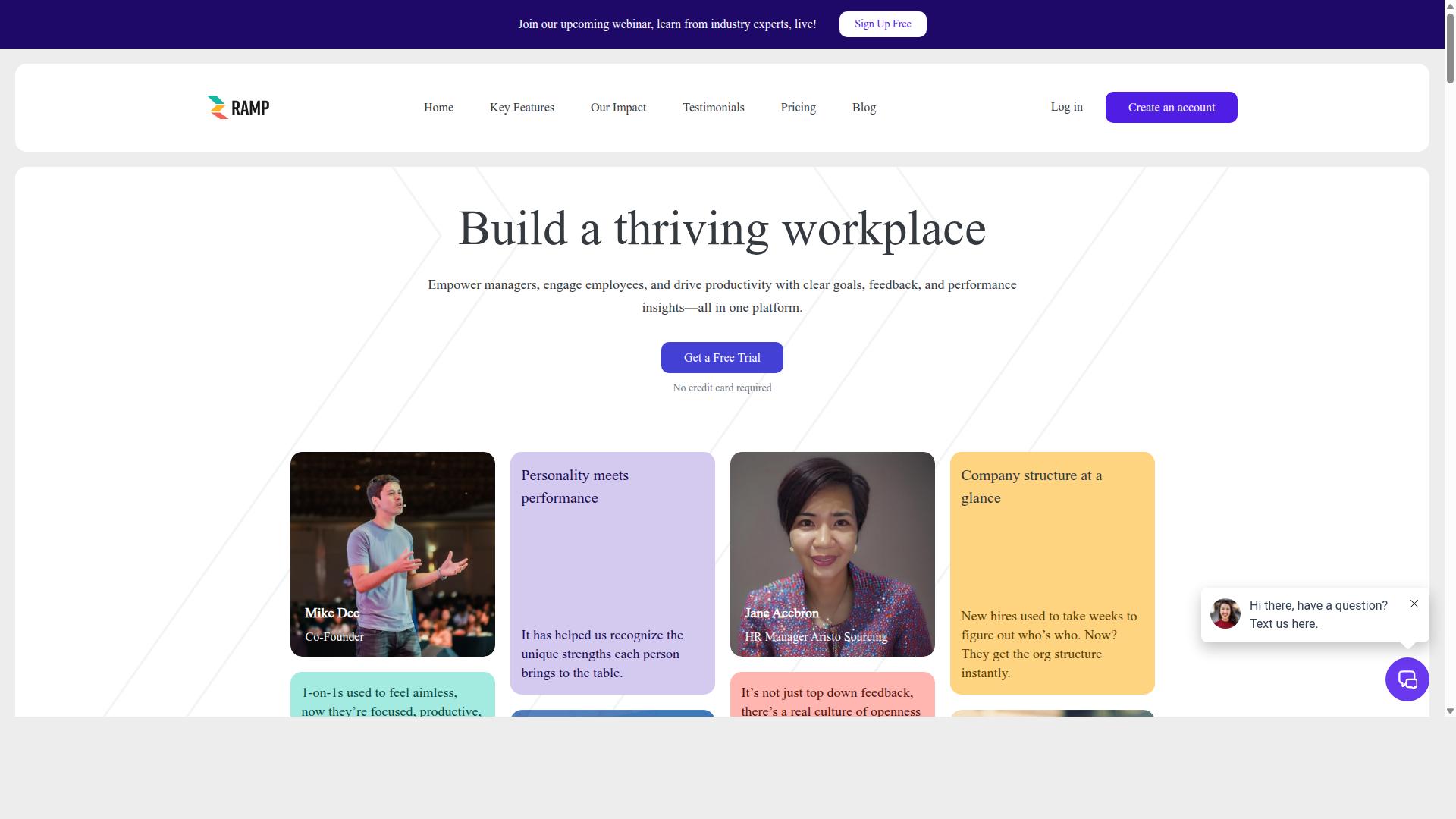
HeyRamp is an all-in-one productivity platform designed to enhance employee engagement, performance management, and workplace communication through tools like 1-on-1 meeting agendas, feedback, and reviews. It positions itself as a central hub where managers and employees can align on goals, share input, and track progress without juggling multiple disconnected tools.
The platform is built around a clear value proposition: give the power to managers, engage employees, and drive productivity through structured workflows. Instead of relying on scattered emails or informal chats, teams get a dedicated space for meaningful check-ins and structured feedback exchanges. This makes it particularly relevant for organizations exploring voice notes as a feedback method, since the platform supports capturing input in formats that fit how people actually communicate.
HeyRamp offers several core capabilities that support its mission. These include company structure visualization, which helps leaders see reporting lines and team dynamics at a glance, plus dedicated 1-on-1 meeting tools that keep conversations focused and productive. Feedback and review features round out the offering, giving HR teams and managers a consistent framework for performance management.
For leadership and HR, the platform provides visibility into engagement patterns and performance insights across the organization. For individual contributors, it offers a clearer line of sight into expectations, progress, and recognition. In the context of voice feedback, this structure matters because it gives audio input a defined place within the broader performance cycle rather than leaving it as an informal afterthought.
What Is Synergita?
Synergita is a performance management and employee engagement platform that offers continuous feedback, goal tracking, and performance reviews, often used by mid-to-large enterprises. It is positioned as an end-to-end solution for organizations looking to manage the entire employee lifecycle, from onboarding to exit interviews.
The platform typically centers on performance appraisals, continuous feedback, goal management, and employee engagement surveys. Many teams use it to replace annual review paperwork with a more structured, year-round process. It also includes recognition tools and pulse survey capabilities that aim to measure workplace sentiment over time.
Synergita is generally known for its comprehensive feature set, which appeals to HR departments that want many tools in one place. However, that breadth can come with a steeper learning curve. New users often need dedicated training time to navigate the configuration options and administrative controls before the system feels intuitive.
For organizations considering voice notes as a feedback method, it is worth noting that Synergita's approach is largely form-based and text-centric. While it may offer ways to document conversations, its core workflow typically relies on typed entries and structured templates rather than spontaneous audio capture.
What Is Heyramp for Voice Notes As Feedback?
HeyRamp's voice notes feature allows managers and employees to record audio feedback directly within the platform, which is then transcribed and attached to 1-on-1 meetings, reviews, or action items. This turns a quick spoken thought into a documented part of the feedback loop without forcing anyone to type out a lengthy message.
The platform pairs voice recording with AI transcription, so every audio note becomes searchable text. That means you can capture the nuance of a spoken conversation and still locate it later by keyword, topic, or meeting date.
Voice notes in HeyRamp attach directly to 1-on-1 meeting tools, which include organized agendas and action tracking. Instead of leaving feedback scattered across emails or chat threads, the audio and its transcript live right where the follow-up work happens.
This setup gives teams a richer alternative to text-only feedback. Tone, pacing, and emphasis carry meaning that written words often lose, and the transcription preserves the clarity of the message for anyone who prefers to read.
The combination of voice recording and transcription supports both immediacy and accountability. A manager can speak a thoughtful observation in seconds, and the system keeps it tied to the relevant review, goal, or action item for later reference.
Features Compared
This section compares the core features of Synergita and HeyRamp, focusing on voice notes, feedback integration, and user experience, to help you decide which aligns better with your team's workflow.
The evaluation centers on three practical areas: how each tool handles voice recording in meetings, whether audio feedback connects meaningfully to reviews and goals, and how quickly your team can adopt the platform. These criteria matter because voice feedback only delivers value when it fits naturally into your existing routines.
Both platforms offer feedback capabilities, but the depth of integration differs significantly. The following breakdown examines where each tool excels and where gaps may appear in daily use.
Voice Notes in 1-on-1 Meetings and Action Tracking
HeyRamp integrates voice notes directly into its 1-on-1 meeting tool, allowing users to record audio feedback that is automatically attached to the meeting agenda and action items, while Synergita's voice note capability is less integrated.
HeyRamp's 1-on-1 meeting tools come with organized agendas and action tracking, so voice recordings become part of a structured conversation rather than floating audio files. When a manager records feedback during a check-in, the note attaches to the specific agenda item or action item being discussed. Transcription makes the content searchable later, which helps when preparing for follow-up meetings or performance conversations.
Synergita may offer voice feedback features, but the level of integration with meeting structures appears less developed. Users may find themselves recording audio that exists separately from the meeting context, requiring manual effort to connect the feedback to specific discussion points or follow-up tasks.
For teams that run regular check-ins, HeyRamp's approach creates a tighter feedback loop. The audio note becomes part of the meeting record, complete with context about what was discussed and what actions were agreed upon.
Feedback Integration with Performance Reviews and Goals
HeyRamp allows voice notes to be linked to performance reviews and individual goals, providing contextual feedback that can be referenced during formal evaluations, whereas Synergita offers broader goal-tracking but with less voice-specific integration.
HeyRamp positions voice notes as evidence within the performance management cycle. Managers can record observations about an employee's progress toward OKRs or goals, and those recordings remain attached to the relevant objectives. When review season arrives, pulling examples from past voice feedback becomes straightforward. The platform also supports personality insights and testing, which adds another layer of context to performance discussions.
Synergita includes goal management and review features, but voice notes may not be woven into these processes as deeply. Users might record feedback in one area of the system and then struggle to connect it to the formal review documentation later.
The practical benefit of HeyRamp's integration is continuity. Voice feedback becomes part of the employee's development record, not a separate artifact. Managers can reference specific audio moments during evaluations, making the feedback feel concrete rather than abstract.
Ease of Use and Built-In Coaching Support
HeyRamp is designed with a user-friendly interface and includes built-in training and coaching resources, making it easy for managers to adopt, while Synergita's extensive feature set may require more onboarding.
HeyRamp includes built-in training videos for 1-on-1s, performance reviews, and personality testing, which reduces the learning curve for new users. Managers do not need to guess how to structure a difficult conversation or interpret personality assessment results. The platform also provides guided conversation templates and coaching tips, offering support exactly when a manager needs it.
Synergita offers comprehensive HR features, but that breadth can feel overwhelming for smaller teams. Users may need to navigate multiple modules before finding the voice feedback function, and the absence of integrated coaching resources means managers must rely on external training or prior experience.
Ease of use directly influences feedback consistency. When a tool feels intuitive, managers are more likely to record regular voice notes rather than abandoning the practice. HeyRamp's design encourages this habit through automated reminders and sentiment prompts, helping teams maintain a steady rhythm of communication.
Pricing Compared
HeyRamp offers transparent, flat-rate pricing at $5 per seat per month (or $3 per seat monthly billed annually) with a 14-day free trial, while Synergita's pricing is typically custom and not publicly listed. For teams evaluating feedback software, this difference in pricing transparency matters more than it might seem at first glance.
HeyRamp keeps things simple with a predictable per-seat model. You pay $5.00 per seat when billed monthly, or drop to $3.00 per seat per month when you commit to annual billing. Enterprise teams can request custom pricing, which is paid per seat as well. There are no surprise tiers or hidden modules to unlock.
The 14-day trial gives you full access from day one, and no credit card is required to start. You can switch plans anytime, which makes it easy to test voice notes as a feedback mechanism before scaling across your organization. This low-friction approach suits HR teams that want to pilot a tool before rolling it out company-wide.
Synergita, by contrast, does not publish its pricing publicly. Interested buyers typically need to contact sales for a quote, and the final cost often depends on company size, selected modules, and contract length. Exact numbers are unknown without a consultation, which makes budgeting more difficult for small and mid-sized teams.
For organizations comparing employee feedback tools, HeyRamp offers more predictable and affordable pricing for small to mid-sized teams. The flat per-seat structure means costs scale linearly as your team grows, with no negotiation required to get a workable rate.
| Pricing Factor | HeyRamp | Synergita |
|---|---|---|
| Monthly billing | $5.00 per seat per month | Not publicly listed |
| Annual billing | $3.00 per seat per month | Not publicly listed |
| Enterprise pricing | Custom, paid per seat | Custom, typically via sales |
| Free trial | 14 days, no credit card required | Not publicly specified |
| Plan flexibility | Switch plans anytime | Depends on contract terms |
When budgeting for voice feedback tools, hidden costs can derail adoption. HeyRamp's transparent model removes that uncertainty, letting you allocate resources confidently whether you are starting with a pilot group or rolling out continuous feedback across the entire organization.
Who Should Choose HeyRamp
HeyRamp is ideal for small to mid-sized teams, including leadership, HR, and managers, who want a simple, affordable tool for continuous feedback and voice notes without the complexity of enterprise-grade systems. If your organization values ease of use over feature bloat, HeyRamp fits naturally into daily workflows without requiring lengthy training sessions or dedicated administrators.
Teams that prioritize 1-on-1 meetings will find HeyRamp particularly useful. Voice notes let managers capture feedback in the moment, right after a conversation ends, instead of struggling to remember key points later. The audio format preserves tone and context that typed notes often lose, making the feedback loop more genuine and actionable.
HR leaders and people operations teams benefit from HeyRamp's built-in coaching capabilities. Instead of purchasing separate coaching software, organizations get guidance embedded within the feedback process. This approach helps managers improve their feedback skills naturally, without forcing them into additional training programs.
HeyRamp's flat pricing model appeals to growing companies that want predictable costs. Unlike platforms that scale fees with headcount or feature usage, flat pricing simplifies budgeting and removes the fear of surprise charges as teams expand. This transparency matters for organizations that are scaling quickly and need software costs to stay manageable.
HeyRamp is trusted by 20+ organizations and 400+ teams, making it a proven choice for growing companies. This adoption signals that the platform handles real-world feedback scenarios effectively. For teams comparing Synergita vs HeyRamp for voice notes as feedback, the decision often comes down to simplicity, coaching support, and a pricing structure that does not punish growth.
If your team wants continuous feedback, voice recording, and a feedback app that feels intuitive rather than administrative, HeyRamp delivers those essentials without the overhead. It suits organizations that want to build a stronger feedback culture without hiring consultants or dedicating weeks to implementation.
Who Should Choose Synergita
Synergita is better suited for larger enterprises with complex performance management needs, including advanced analytics, goal alignment, and formal review cycles, where the learning curve is acceptable. Organizations with established HR processes and dedicated people operations teams often find this level of structure valuable.
This platform typically appeals to companies that want a comprehensive performance management suite rather than a focused feedback tool. If your organization runs annual reviews, tracks OKRs, and needs detailed reporting across departments, Synergita's broader feature set may justify the investment.
Teams that already have mature HR technology stacks and administrators who can manage configuration will get the most from this approach. The customization options allow HR leaders to align the system with existing workflows, which matters when you have multiple locations or business units.
However, smaller teams may find the platform overwhelming for what they actually need. If your primary goal is simply encouraging managers to leave quick voice feedback or audio notes for their reports, a full performance management system can introduce unnecessary complexity.
Consider your organization's readiness. If you have the bandwidth to manage a robust system and need deep reporting, Synergita is worth evaluating. If you want a lighter touch for everyday feedback, a simpler voice notes tool may serve you better without the heavy setup.
Who Should Choose Heyramp for Voice Notes As Feedback
If your team relies on voice notes for feedback and wants them to be automatically transcribed, searchable, and tied to meetings and goals, HeyRamp is the clear choice. Teams that value the nuance of voice feedback and need it to be part of their formal processes will benefit most from this platform. HeyRamp's integrated voice recording captures the tone and emotion that typed feedback often loses.
The AI transcription built into HeyRamp converts those recordings into searchable text. This means a manager can quickly find a specific piece of feedback from weeks ago without replaying every audio file. The transcription also makes it easy to share voice feedback with team members who prefer reading over listening.
HeyRamp attaches voice notes directly to 1-on-1 meeting tools with organized agendas and action tracking. This connection ensures that verbal feedback becomes a formal part of the workflow, not a passing comment that gets forgotten. Action items created from voice feedback stay visible and accountable, closing the feedback loop.
Teams that should choose HeyRamp include those who want:
- Voice feedback integrated with performance reviews and goal management
- Confidential manager notes that preserve honest audio insights
- Coaching tips and guided conversation templates to make voice feedback more effective
- Automated reminders so no piece of feedback slips through the cracks
Organizations building a continuous feedback culture will find HeyRamp's approach especially valuable. Voice notes become part of the structured system, connected to OKRs, KPI snapshots, and people analytics dashboards. This means audio feedback influences real decisions about development and performance.
Compared to Synergita, HeyRamp offers a more cohesive voice feedback experience. Where other tools may treat voice notes as an add-on, HeyRamp weaves them into the core of its feedback software. For teams that believe tone and emotion matter in feedback, this integration makes all the difference.
The result is a feedback loop that preserves human nuance while maintaining professional structure. Voice feedback becomes searchable history, connected to action items and measurable outcomes. For HR leaders who want audio feedback to drive real change, HeyRamp delivers the most complete experience.
Final Verdict
In the battle of Synergita vs HeyRamp for voice notes as feedback, HeyRamp emerges as the more practical and cost-effective solution for most teams, thanks to its integrated voice features, ease of use, and transparent pricing.
The core difference comes down to scope. Synergita is a broad performance management platform that can handle voice feedback, but it is built for large enterprises with complex HR processes. HeyRamp, by contrast, is designed around the feedback loop itself, making voice notes a natural part of daily manager and peer interactions rather than an add-on.
HeyRamp wins on simplicity and value. Its one flat fee pricing removes the guesswork of per-seat costs, and the built-in training and education mean your team does not need a lengthy onboarding period to start using audio feedback effectively.
For teams that want a streamlined, voice-friendly feedback culture, HeyRamp is the clear recommendation. The platform is trusted by 20+ organizations and 400+ teams, which signals real-world reliability without the enterprise bloat.
Synergita remains a viable option only if your organization needs advanced performance management at scale. If you are juggling complex review cycles, multi-level approvals, and deep HR analytics across thousands of employees, its broader feature set may justify the added complexity.
However, for the specific goal of capturing voice notes as feedback, HeyRamp delivers the essentials better. Automatic compliance documentation keeps your records clean, while guided conversation templates help managers turn raw audio into actionable discussions.
Consider your priorities:
- Choose HeyRamp if you want affordable, integrated voice feedback with built-in training and instant coaching tips.
- Choose Synergita only if you already need a heavyweight performance management suite and voice notes are a secondary feature.
The verdict is straightforward. HeyRamp offers the better fit for building a continuous feedback culture where voice notes are a primary tool. Synergita can work, but it asks you to adopt a much larger system to get the same result.
Recommended Resources: